
Reviewed · MEXICO CITY TOURS
Iztapalapa: Cable Car Tour and Urban Art From the Heights
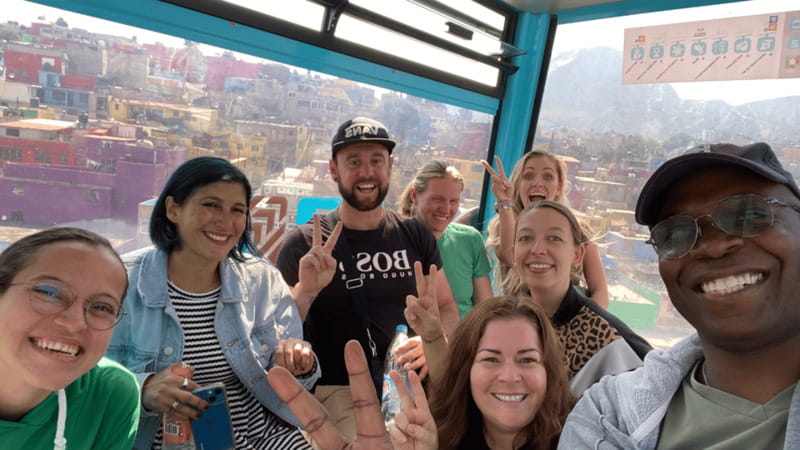
Iztapalapa comes into view from an unusual angle: high above the streets in a Cablebús cabin, with rooftops, murals, crowded neighborhoods, and distant volcanoes spread below you. This four-hour outing starts at Bellas Artes and uses Mexico City’s metro and cable car network to reach a part of the city that most sightseeing routes skip.
I like the way the tour teaches you to use public transportation, not just look out a window. I also like the rooftop art and the chance to connect it with local stories, music, food, and community life. The main tradeoff is time: a fair part of the morning or afternoon is spent on the metro, and one London-based guest found the subway explanations longer than needed.
This is not a traditional walking tour. It is a small-group ride through the city’s daily transport system, with short stops for views, history, photography, food, and a tortilla activity. Guides such as Eduardo, Benjamin, Oscar, Gabi, and Alexia have earned especially warm praise for making first-time metro users feel at ease.
Key points at a glance

- The Cablebús is the main event: You see Iztapalapa, its rooftops, murals, streets, and surrounding mountains from above.
- The metro lesson has real value: Your guide helps you understand Mexico City’s huge public transport system from the start.
- The art has a purpose: Rooftop murals are tied to the people, stories, and daily life of the neighborhoods below.
- You visit beyond the usual tourist circuit: Iztapalapa offers a more everyday view of Mexico City than the Historic Center or Roma.
- Food connects the outing to daily life: Tortillas are included, while gorditas cost an extra 15 pesos and other meals and drinks are separate.
- The format is easygoing but not effortless: You avoid a long walking route, yet you still need to manage metro stations, transfers, and short neighborhood stops.
Why the Cablebús changes your view of Mexico City

Mexico City is so large that its scale can be hard to grasp from street level. The Cablebús gives you a moving panorama of that scale. As the cabin passes over Iztapalapa, you see the tight pattern of homes and streets, painted roofs, public art, transport lines, and the mountains around the city.
The attraction is not only the height. The ride shows how public transport reaches communities that sit far from the central districts most visitors know. You get a practical lesson in how the city connects its outer neighborhoods, along with a view that would be difficult to find from a normal sightseeing bus.
The route has been described as the world’s longest public transport cable car. The cabins are modern, clean, quiet, and designed for daily use rather than tourism alone. That distinction matters. You are not riding a decorative attraction built for visitors. You are seeing a working part of Mexico City’s transport network.
The views depend on weather and visibility, but the setting itself is unusual. Look down for the murals and rooftops, then out toward the volcanoes and the broad spread of the city. Your guide points out details that are easy to miss when you are simply taking photographs.
A few more Mexico City days worth comparing
- Balloon flight + Breakfast in cave + Pyramids + Pick up CDMX.
★ 5.0 · 6,335 reviews - Balloon flight + pick up in CDMX + Breakfast in Cave + Pyramids
★ 5.0 · 5,651 reviews - Balloon Flight + Cave Breakfast + Pick Up from CDMX or We Fly
★ 5.0 · 4,410 reviews
Starting at Bellas Artes and learning the metro
The meeting point is at the Parisian entrance of the Bellas Artes subway station, on the left side of the Palace of Fine Arts. Look for a guide wearing a green shirt and carrying a green umbrella. This detail is worth taking seriously. One person had trouble finding the guide, so arrive with the meeting point saved on your phone and keep your WhatsApp contact available with the correct area code.
From Bellas Artes, you spend about 45 minutes using the metro. The return trip takes another 40 minutes, so public transport accounts for a large portion of the four-hour outing. That may sound like a drawback, but it is also one of the tour’s most useful features.
Mexico City’s metro can feel confusing at first. Stations are large, signs use Spanish, and the network covers a great deal of ground. Your guide handles the practical parts: where to go, how to follow the route, and how the metro connects with the Cablebús.
If you already use large metro systems, you may find this section slower than necessary. A visitor from London specifically felt that the explanations could have been shorter. If you are new to Mexico City public transport, though, the time is well spent. Several guides, including Benjamin, Oscar, and Eduardo, have helped people gain enough confidence to use the metro later in their trip.
The public transport card is included, as are the metro and Cablebús rides. That makes the first part simple. You do not need to figure out the ticket system while also trying to keep up with a group.
Riding over Iztapalapa’s rooftops and murals

The Cablebús ride takes about 40 minutes on the way out, followed by another ride of about 25 minutes later in the route. That is enough time to settle into the cabin and watch the city change beneath you.
The rooftops are the star. Large murals appear from a viewpoint that street-level visitors rarely get. Some are painted on walls, while others are designed to be seen from the cable car itself. Your guide explains the images, how they were created, and what they mean to people commuting below and above the neighborhood.
This is where the tour moves beyond simple sightseeing. The murals are not just colorful decoration for your camera. They connect to local identity, public space, and the effort to give a more visible voice to communities often left outside standard visitor routes.
Alexia has been especially praised for explaining how the murals affect daily commuters. That is a useful way to understand the art. You are not only looking at a painted surface. You are seeing work designed for people who pass it every day.
The cabin also gives you a clear sense of the neighborhood’s physical shape. The streets can look maze-like from above, while the surrounding mountains help you understand where Iztapalapa sits within the wider city. The combination of dense urban development and distant peaks gives the ride its strongest visual contrast.
Bring a phone or camera, but do not expect every photograph to be perfect. Reflections from the cabin windows may interfere, and your best view can change quickly as the car moves. Your guide’s commentary is more valuable than trying to capture every second.
A park, distant volcanoes, and the story of Iztapalapa
The route includes a stop in a local park, where you can see the volcanoes and the city in the distance. The stop lasts about 20 minutes as a guided visit, followed by a roughly 15-minute photo stop in Iztapalapa.
These pauses give your eyes a break from the moving cabin and let the guide explain how the area has grown. You hear about Iztapalapa’s development, the challenges it has faced, and the way its communities have changed over time.
The emphasis is on people and daily life, not only dates and monuments. You learn about local music styles such as cumbia, sonidero, and urban rock. That musical context helps make sense of the neighborhood as more than a collection of buildings seen from a cable car.
The park stop also changes the pace. You are no longer looking down through a cabin window. You can pause, take photographs, and listen while facing the wider city. If the air is clear, the mountain views add a memorable backdrop.
The tour is promoted as a way to see Iztapalapa without walking, but you should read that carefully. It is not a four-hour hike, and transport does most of the work. Still, moving through stations, boarding trains, reaching a park, and visiting a local area requires some walking and standing. Comfortable shoes are essential.
A completely different kind of day out, same trip:
- Hot Air Balloon Flight with Breakfast Cave and Pyramids Tour
★ 5.0 · 2,066 reviews - Balloon flight with breakfast in Cave and Pyramids tour from CDMX
★ 5.0 · 1,504 reviews - Balloon Flight + Breakfast in a cave + Pick up CDMX + Pyramids
★ 5.0 · 1,479 reviews - Chapultepec Castle & Anthropology Museum Tour
★ 4.5 · 1,348 reviews
Tortillas, gorditas, and a local food stop
Food gives the outing a more personal focus. Tortillas are included, and the activity introduces their role in Mexican meals and culture. You get to take part in making them rather than treating food as a quick snack between transport connections.
The tortilla activity matters because tortillas are not a side detail in Mexican cooking. They are an everyday food with a place at breakfast, lunch, dinner, markets, and family tables. Making one by hand gives you a simple way to connect the city tour with home life.
The experience can also include time at a local market or food stall. Several outings have featured gorditas, tacos, fruit juice, sweets, and fresh tortillas. A gordita costs 15 pesos, while meals and drinks are not included in the tour price. Bring cash if you want to try something beyond the included tortillas.
You should not book this for a formal food tour. The food is part of a broader route about transport, art, and community. But it can become one of the best moments because you are eating in the same kind of local setting that the tour is designed to show.
Your guide’s choices matter here. Gabi, Oscar, and Tomas have been singled out for helping people find local specialties. If you have allergies or dietary limits, ask before buying anything, since the supplied information does not give a specific food policy.
What the $24 price really covers
At $24 per person, this is a strong value if you want transport guidance and local context as much as sightseeing. The price includes the public transport card, metro and Cablebús rides, an expert guide, educational material, and tortillas.
You are paying for a small group of no more than nine people. That size makes it easier to ask questions and stay together during station changes. It also gives the guide room to explain what you are seeing without trying to speak over a large crowd.
The value is less obvious if you only want a cable car ride. You could think of the metro time as extra travel rather than part of the attraction. You also pay separately for food, drinks, tips, and gorditas. Still, arranging the route, navigating the stations, explaining the city, and providing the transport card adds practical value.
The strongest reason to book is the combination. A cable car trip alone gives you views. A metro ride alone gives you transport practice. Together, with the murals, park, music, tortilla activity, and neighborhood stories, they create a fuller picture of Mexico City outside the central tourist zones.
Free cancellation is available up to 24 hours before the start, and you can reserve now and pay later. Check the starting time when booking because the activity lasts four hours and departure times vary.
Who will enjoy this outing most

I would choose this tour if you want to see a less familiar part of Mexico City and prefer local transport to a sightseeing coach. It suits first-time visitors who feel nervous about the metro, as well as repeat visitors who have already seen the Historic Center and want something different.
It is particularly good for people interested in:
- Public transport and city planning
- Community murals and public art
- Mexico City neighborhoods beyond the central districts
- Local music and food traditions
- Large-scale views rather than museum interiors
- A small group with English or Spanish guiding
The tour is not a good match for people with vertigo, motion sickness, or seasickness. It is also not suitable for children under five, people with respiratory issues or altitude sickness, or anyone over 220 pounds, or 100 kilograms.
The clothing rules are stricter than on many city tours. Wear comfortable shoes and discreet clothing. Avoid high heels, sandals, flip-flops, shorts, short skirts, sleeveless shirts, and sunglasses. Oversize luggage, large bags, drones, bicycles, scooters, and non-folding wheelchairs or strollers are not allowed.
The restrictions may feel fussy, but they are useful to know before you arrive. The group uses public transport and a working neighborhood route, not a private tour vehicle with room for extra belongings. Leave valuables and bulky bags at your accommodation.
Guide quality and group size
The guide can shape the whole experience. Eduardo, Benjamin, Oscar, Gabi, Alexia, Tomas, Gabriel, Gabriella, and others have led this route. The strongest descriptions focus on clear explanations, kindness, good timing, and the ability to put first-time metro users at ease.
Benjamin has been praised for explaining both the transport system and the history visible from the Cablebús. Oscar has been valued for giving people confidence in less familiar parts of the city. Alexia has brought attention to the murals and their effect on commuters. These names are useful to know, but the guide assigned to your departure can vary.
English and Spanish are available. Some material may be presented in its original language, so ask your guide to clarify anything you miss. The small group limit of nine is a real advantage during transfers and photo stops, when a large party would be harder to manage.
The overall rating is 4.9 from 124 reviews, with repeated praise for the guides, the cable car views, the public transport lesson, and the chance to visit a non-tourist area. The recurring caution is also clear: if you already know large subway systems, you may want a shorter explanation of the metro.
Is the Iztapalapa Cablebús tour worth booking?

I would book it if you want to understand how Mexico City works, not just photograph its famous center. The Cablebús ride is memorable, but the best part is the connection between the transport network, rooftop murals, local music, food, and the history of Iztapalapa.
Choose another activity if you want a relaxed walking-free ride with almost no transit time, or if you dislike heights and crowded public transport. You also need to follow the clothing and baggage rules closely.
For $24, the combination of transport fares, a small group, a guide, city views, public art, and food culture is hard to beat. Meet at the Parisian Bellas Artes entrance with comfortable shoes, cash, and an open schedule. You will return with more than photographs: you will understand a little better how Mexico City connects its people.
FAQ
Where does the Iztapalapa Cablebús tour begin?
Meet at the Parisian entrance of the Bellas Artes subway station, on the left side of the Palace of Fine Arts. Guides wear a green shirt and carry an umbrella.
How long does the tour last?
The experience lasts about four hours. The route includes metro travel from Bellas Artes, Cablebús rides, guided time in Iztapalapa, a photo stop, scenic views, and the return journey.
Is transportation included?
Yes. The public transport card, metro rides, and Cablebús rides are included in the price.
Is food included?
Tortillas are included. Meals and drinks are not included, and gorditas cost an additional 15 pesos. Bring cash if you want to buy local snacks.
Is the tour offered in English?
Yes. Live guiding is available in English and Spanish. Some content may be presented in its original language.
Who should avoid this tour?
The experience is not suitable for children under five, people with vertigo, respiratory issues, altitude sickness, motion sickness, or seasickness, or people over 220 pounds, or 100 kilograms. High heels, sandals, flip-flops, shorts, short skirts, sleeveless shirts, large bags, and several other items are not allowed.
Just added around Mexico City
- Kayaking on the Island of Sacrifices★ 5.0 · 49 reviews
- Paragliding in Valle de Bravo★ 5.0 · 188 reviews
- Hot Air Balloon Flight and Tour of the Majestic Pyramids★ 4.5 · 38 reviews
- Balloon flight / Breakfast in the cave / CDMX pick-up + Pyramids★ 5.0 · 54 reviews
- Hot air balloon ride with breakfast in Cueva from CDMX★ 5.0 · 47 reviews
- Africam safari (private tour)★ 5.0 · 33 reviews
- Lucha Libre, Tacos, Margaritas,Tequila and Night Market Tour★ 5.0 · 64 reviews
- Riviera Maya: Frida Kahlo Museum Guided Tour 2025★ 4.1 · 54 reviews
Mexico City Tours, compared.
Balloon flight + Breakfast in cave + Pyramids + Pick up CDMX.
Read our review →
Balloon flight + pick up in CDMX + Breakfast in Cave + Pyramids
Read our review →
Balloon Flight + Cave Breakfast + Pick Up from CDMX or We Fly
Read our review →
Hot Air Balloon Flight with Breakfast Cave and Pyramids Tour
Read our review →
Balloon flight with breakfast in Cave and Pyramids tour from CDMX
Read our review →
Balloon Flight + Breakfast in a cave + Pick up CDMX + Pyramids
Read our review →
Chapultepec Castle & Anthropology Museum Tour
Read our review →
Browse the lists this tour appears in